
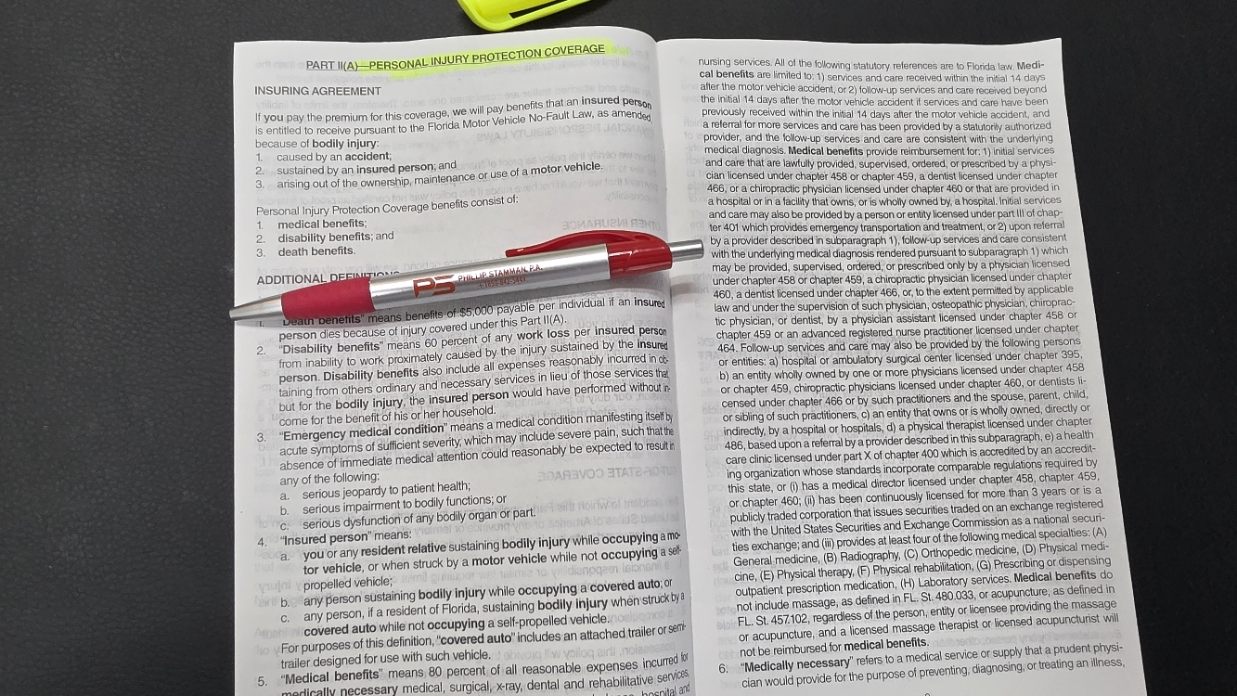
Florida PIP covers three things: 80 percent of your reasonable medical bills, 60 percent of your lost wages, and a $5,000 death benefit, all sharing a single $10,000 limit on a standard policy. It pays no matter who caused the crash, which is what “no-fault” means in Florida.
A few states have PIP, but most do not, and Florida is one of the few that requires it of every registered vehicle owner. That matters here, because Panama City Beach is full of drivers who came from somewhere else: if you are visiting from out of state, your own policy may have no PIP at all, and who pays your medical bills is a different question entirely.
What does PIP actually cover?
Under Florida Statutes section 627.736, PIP breaks into three buckets:
- Medical: 80 percent of reasonable expenses for medically necessary medical, surgical, X-ray, dental, and rehabilitative care, including ambulance and hospital. The messier version: “reasonable” and “medically necessary” are both fighting words in a PIP dispute.
- Disability: 60 percent of lost gross income and earning capacity, plus the reasonable cost of household services you can no longer perform. The messier version: proving lost earning capacity for someone self-employed is its own project.
- Death: $5,000 per person.
Two things about that $10,000. It is one pot shared by all three, so heavy treatment can consume it before anyone reaches the wage claim. And your policy may carry a PIP deductible, which Florida allows up to $1,000, coming off the top before any of it starts.
Why is my $10,000 sometimes only $2,500?
Because the full benefit requires a finding that you had an emergency medical condition. Without it, your PIP medical benefit caps at $2,500.
The statute limits who can make that call to a medical doctor, an osteopathic physician, a dentist, a physician assistant, or an advanced practice registered nurse. A chiropractor cannot, which matters because chiropractic care is otherwise fully covered and is where many crash victims end up.
Here is the part most articles about this get wrong. In practice it is much less of a trap than it is made out to be. Chiropractic clinics that regularly handle auto injuries know exactly how this works, and they either run a telemedicine visit with a qualifying provider or have someone on staff who can review for the determination. It is a normal part of their intake. Ask about it at your first visit, but do not panic about it. If you went to a hospital or urgent care first, that determination has usually already been made, which is one thing to weigh when deciding whether to go to the ER or urgent care.
What does PIP not cover?
- Your car. PIP covers people. Repairs come from collision coverage or the at-fault driver’s property damage liability.
- Pain and suffering. That requires clearing a separate legal threshold, which I walk through in am I entitled to pain and suffering damages in Florida.
- Massage and acupuncture. Excluded by statute, no matter who provides them.
- The other 20 percent and 40 percent. PIP pays a share, not the whole bill.
- Anything after 14 days. If your initial care is not rendered within 14 days of the crash, your PIP medical benefits are gone. The clock runs from the crash date, not from the day you started hurting.
Most people learn all of this after they need it. It is worth reading your own policy before you do.
Does it matter which provider I use for PIP?
More than anything else on this page. Not because some providers are better doctors, but because some know how to bill PIP correctly and on time, and some do not.
Providers have a deadline of their own: a bill must be postmarked within 35 days of the service, extendable to 75 days if the provider gave notice that treatment had begun within 21 days. Miss it and the insurer is not required to pay.
Sometimes the adjuster approves it anyway, and that is the part I want people to understand. Sometimes the adjuster is simply being reasonable. They are not required to be, and lately I am seeing carriers work considerably harder to find ways to deny PIP payments than they used to. Building your treatment on the hope that an adjuster will be generous about a late bill is not a plan.
So the question is not just whether a clinic takes PIP. It is whether they bill it as a routine, promptly, in a practice where getting those bills out the door is somebody’s actual job. A clinic that handles auto injuries every week has that person. A clinic that sees one crash patient a quarter may not. That is one of several reasons the choice of provider matters so much.
What I hand every client on day one
When I take on a new client, I explain how PIP works, and then I make sure the billing information reaches the right hands immediately. I print a one-page sheet with their PIP information on it, along with their health insurance as secondary coverage if they have any, and they hand a copy to every provider who treats them.
It sounds too simple to matter. It matters because nearly every PIP billing problem I see traces back to a provider who did not have the information, or had the wrong information, or had it three weeks late. The front desk cannot bill what it does not have.
Bring the health insurance too, if you have it. PIP gets billed first and health insurance sits behind it as secondary, which absorbs what PIP does not and keeps your treatment going after the PIP money runs out, often exactly when your doctor is telling you to continue. Ask whether a clinic takes it at the first visit, not the fifth.
You can do all of this without a lawyer. Write down your auto carrier, policy number, claim number, and health insurance details, and give a copy to every new provider you see.
Will my rates go up if I use my own PIP?
Under Florida Statutes section 626.9541, an insurer may not charge you an additional premium or refuse to renew your policy solely because you were involved in a motor vehicle accident, unless its file contains information from which it determines in good faith that you were substantially at fault. Note the operative words: solely and substantially at fault. If somebody rear-ended you at a light on Back Beach Road, the law does not permit your carrier to raise your rates for the sole reason that you used the coverage.
Which brings me to what I find myself saying most often. This is what insurance is for. You have paid a premium every month for years in exchange for a promise that the coverage would be there. Something happened. Declining to use the benefit you bought, to protect a rate the law already protects, means you paid for nothing.
Key takeaways
- PIP covers 80 percent of medical bills, 60 percent of lost wages, and a $5,000 death benefit, sharing one $10,000 limit, regardless of fault.
- Your initial care must happen within 14 days of the crash or the medical coverage is gone.
- The full $10,000 requires an emergency medical condition determination. Without it you are capped at $2,500, though clinics that handle auto injuries routinely have a process for this.
- Timely billing is where claims actually break. Providers get 35 days to postmark a bill, and insurers are increasingly willing to enforce it.
- Give every provider your PIP and health insurance information at the first visit, in writing. This one habit prevents most PIP billing problems.
None of this requires a lawyer to understand. It does tend to require one to enforce, because the deadlines run quietly and the denials arrive after the treatment is over, when your options have already narrowed.
If you were hurt in a crash and you were not at fault, I will talk it through with you at no charge, and there is no fee unless we recover for you. You can reach me, Phillip Stamman, at my Panama City Beach office: call (850) 842-5449 or contact me here for a free consultation. If you want to know how attorney fees work first, here is what car accident lawyers actually charge in Florida, and you can read more about how I handle car accident cases in Panama City Beach.
This post is general information about Florida law, not legal advice, and reading it does not create an attorney-client relationship. Policy language varies, so read your own policy. Every crash is different; talk to a lawyer about your specific situation.
Stay safe out there,
Phillip Stamman
Solo Personal Injury Lawyer
Panama City Beach, Florida